
Shares of Life Insurance Corporation (LIC) of India hit fresh record lows amid sustained decline in Adani Group stocks. Its stock finished at Rs 567.8, down 2.9 per cent over its previous close. The state-owned insurer's market value is now down Rs 2.4 trillion, or 40 per cent, compared to initial public offering levels.

Indian charitable trusts, including Tata Trusts and top corporate donors, are stumped by a new tax law proposed in the Budget, which reduces tax breaks for the donor organisations. The Finance Bill proposes that if a charitable organisation donates to another charity, then only 85 per cent of the donation will be considered as application of income for the donor organisation. Trust officials say this is a major setback for the donor organisations, including corporate foundations and intermediary organisations, which work with various implementing agencies at the grassroots level.

The Securities and Exchange Board of India (Sebi) has proposed to put a stop to the practice of certain directors occupying permanent board seats at listed companies. The regulator has suggested that the directorship of any individual serving on the board should be subject to periodic approval from shareholders, at least once in five years. In a discussion paper issued on Tuesday, Sebi said a few promoters enjoyed permanency on the board, giving them an undue advantage, prejudicial to the interests of public shareholders.

Adani Enterprises, the flagship of Adani Group, said on Wednesday new businesses of renewables, data centres, airports and roads account for more than 33 per cent of earnings and it will complete all infrastructure projects on time. "We are laser focused on continuing our business momentum, in this market volatility. "We are confident in our internal controls, compliance and corporate governance.

Despite the recent turmoil in the Indian markets after a scathing report on the Adani group from Hindenburg Research, American private equity major Blackstone is "bullish" on the India growth story and plans to invest more in the country's infrastructure and real estate projects. "We have a long-term view on India, as growth will be higher here. We have invested half of our Asia exposure in India. "Our extraordinary performance in India has made us bullish," said Jonathan Gray, president and chief operating officer of Blackstone.
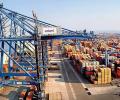
A day after the promoters of Adani Group prepaid $1.1 billion loans, one of the group's listed entities - Adani Ports and Special Economic Zone (APSEZ) - announced that it would prepay loans of up to Rs 5,000 crore by next month-end so as to improve its financial metrics. The company is targeting an earnings before interest, tax, depreciation and amortisation (Ebitda) of around Rs 15,000 crore this financial year. This was revealed by Karan Adani, chief executive officer (CEO) and whole-time director of APSEZ, while announcing the September-December 2022 results.

Friday will be a landmark day for domestic markets, with all the listed stocks entering the professed T+1 (trading plus one day) settlement cycle. About 200 stocks, which account for more than 80 per cent of India's market capitalisation, will be settled on a next-day basis, with effect from January 27. This will evidently complete the transition to the T+1 cycle that started in February 2022 with the bottom 500 stocks in terms of market value.

Aided by the $57.8-billion merger of HDFC Bank and HDFC, India Inc reported its highest ever mergers and acquisitions in calendar 2022 at $171 billion as against deals worth $145 billion announced last year. The acquisition by the Adani group across cement, media and ports dominated the headlines with the conglomerate making its foray into the cement sector by buying Swiss materials firm Holcim's stake in Ambuja Cements for $6.5 billion. The Adani family's additional $4-billion open offer for Ambuja did not get a response because shareholders preferred to stay invested with the new owner.

Sundararaman Ramamurthy has been an interesting choice for the publicly-listed BSE, which has seen its chief move to bigger rival -- the National Stock Exchange (NSE) -- in July. Having spent nearly two decades at the country's largest bourse, Ramamurthy is among the early architects of NSE and understands all the cogs of the exchange wheel like only a few others in the country. Just like NSE's core team, which includes its founder RH Patil, the 59-year-old Ramamurthy has worked at the Industrial Development Bank of India (IDBI) before moving to NSE in 1995.

'Yet the market didn't do all that badly because it was cushioned by domestic inflows.'

In a setback to Tata Power, the Supreme Court on Wednesday dismissed the company's challenge to the Maharashtra Electricity Regulatory Commission's (MERC's) decision to award a Rs 7,000-crore transmission project near Mumbai on a nomination basis to Adani Electricity. The court upheld the order by the Appellate Tribunal for Electricity (APTEL) in this case and directed all State Electricity Regulatory Commissions to frame guidelines on tariff determination in accordance with Section 61 of the Electricity Act and the national policy. The verdict has implications for the Mumbai power market, said Ashok Pendse, an energy expert based in the city.

Foreign currency loans raised by Indian companies nosedived to $210 million in the September quarter (Q2), 93.3 per cent less than the year-ago period when five firms raised $3.1 billion. The Q2 amount is the lowest since December 2003 quarter when India Inc raised $191 million. Companies cited volatility in the currency markets, sharp rise in interest rates in the United States, and fund availability in India as the main reasons behind the sharp fall.

Fuelled by the $57.8-billion merger of HDFC twins (HDFC Ltd and HDFC Bank), M&A (merger and acquisition) transactions in India touched a record high of $124.2 billion in the first half of 2022-23. Bankers said with several transactions, including the government's stake sale in IDBI Bank and Hindustan Zinc in the pipeline, the ongoing financial year will end up as the best year for M&A activity in the country. Apart from the HDFC transaction, the $6.5-billion acquisition of Holcim stake by the Adani family and L&T's $3.2-billion acquisition of Mindtree added to the record transactions in the first half of FY23.

Two firms belonging to the Adani group - India's most valued conglomerate - are part of the Nifty 50 index. The group, however, has no representation in the Sensex. And it could stay this way if a proposed index qualification rule change gets approved. Recently, Asia Index, a joint venture between S&P Dow Jones Indices and BSE responsible for index composition, floated a consultation paper where it proposed that a stock must have a derivative contract to be eligible for inclusion in the flagship 30-share Sensex index.

The Piramal group and Zurich Insurance have decided to jointly bid for Reliance General Insurance, a subsidiary of Reliance Capital. The groups had earlier submitted separate bids for the general insurance business of bankrupt Reliance Capital. Both Piramal and Zurich will hold 50 per cent each in the proposed special purpose vehicle (SPV).

The Tata group is planning to invest $90 billion in new industries such as mobile components plant, semiconductor, electric vehicles, batteries, renewables energy and e-commerce by 2027. The Tata group's investment in India is far higher than the $75-billion investments planned by Mukesh Ambani-owned Reliance Industries and $55-billion investment planned by the Adani group in the next five years in the country, the Economist reported recently. The investment by the Tata group is a shift in its strategy to focus more in the home markets instead of international markets where the group lost money.

The Rs 38-trillion mutual fund (MF) industry is going through a new fund offer (NFO) rush. Since July 1, the industry has launched close to 70 NFOs. This follows the completion of a near three-month embargo period when the industry had vowed to not launch any new offerings till the time it implemented norms around pooling of investor accounts. As a result, between April and June 2022, the industry was able to launch just three NFOs.

The Adani group said Reliance Infrastructure, part of the Reliance Anil Dhirubhai Ambani Group, had initiated arbitration on one specific dispute under the Share Purchase Agreement (SPA) in December 2021 with a claim for just Rs 500 crore. Adani said it has filed counterclaims against the Ambani company. The Adani group firm, Adani Electricity was reacting to a Reliance Infrastructure statement of last week, which said it has filed an arbitration claim of Rs 13,400 crore against Adani Group in the Mumbai Centre for International Arbitration (MCIA). Reliance had cited a breach of a December 2017 share purchase agreement relating to the transfer of its Mumbai power distribution business to Adani Transmission.

In August, domestic equity markets garnered one of the highest foreign portfolio investor (FPI) flows since the outbreak of the pandemic in 2020, despite the US Federal Reserve standing firm on unwinding its stimulus measures to control inflation. FPIs pumped in over Rs 51,000 crore ($6.4 billion) in August, the most since December 2020 and the third-highest tally since March 2020-the month the Covid-19 pandemic roiled global markets. This was the second consecutive month of positive foreign flows. In the preceding nine months, FPIs had yanked out over $32 billion or Rs 2.2 trillion.

'The idea is to invest where there is opportunity.'
 © 2026 Rediff.com - Advertise with us - Disclaimer - Privacy Policy - Sitemap - Feedback - About us - Terms of use - Grievances